My Trans Day of Visibility speech on pathways to power
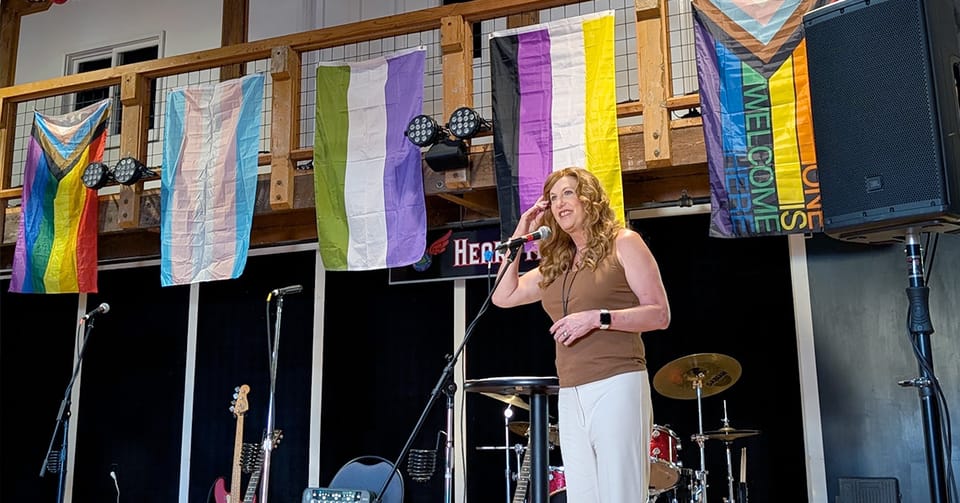
Last week I gave my first in-person speech since coming out as trans. Fittingly, it was at the Trans Day of Visibility event organized by Celebrate Love and hosted at Life on Art in Petaluma.
I spoke about a topic near and dear to my heart: Pathways to power and bringing our lived experience as marginalized people to bear on the decisions that shape our day to day lives.
Below is an approximation of the transcript. Endless love to Athena, Cyd, and Sam for organizing such a wonderful event 💖
Transcript
Hi folks, my name is Robin, pronouns she/they, and I wear a lot of hats.
I’m the longest serving board member with Petaluma Pride, a co-organizer of North Bay Python, Petaluma’s commissioner for the Sonoma County Library, a chapter leader with ACLU NorCal Sonoma County, a former campaign manager twice over, ... and so on. It’s a lot. I blame the ADHD.
But basically I'm a community organizer who specializes in organizational development, civics, and technology.
And… in December of 2024, I realized that I’m trans. Nonbinary transfemme to be exact but let's not split hairs. My journey as a trans person is still new.
I don’t have wisdom to offer on that front, at least not to a room full of fellow trans folk. But I did come out as bisexual in 2008, have long lived out loud, and I know something about the power of storytelling. I also know about the importance of bringing that to bear in self-governance.
Today I want to share my story and the impact living out loud has had. Then I'll illuminate a few local trailheads for pathways to power, so that we can inform the decision-making that shapes our daily lives.
My story
I’ve been out as bisexual for 18 years. I came out the night Californians passed Prop 8, banning same-sex marriage.
It only dawned on me the month before that I was bi. Though I had plenty of, ah, evidence, I hadn't even realized bisexuality was a thing... Because I had spent many of my teenage years in the deep end of Christian fundamentalism here in town at Calvary Chapel Petaluma. I just thought I was gay and "God" was helping me become straight.
As the election results poured in that night, I knew it was time. There was no sense in waiting longer, and more people needed to realize they knew someone impacted by this terrible vote.
I’ve lived out loud ever since. Coming out as bi, my struggles with ADHD, counting pennies to feed myself when I lived in poverty, and grappling with depression. I've never been shy about these things.
But being publicly vulnerable comes with risks. Sometimes I doubt it's worth it.
Then I think to myself, I’m a middle class white person in the US... If I can’t take the risk to tell my story, how can I expect anyone else to?
Plus, when I live out loud I learn. Road testing my worldview and lived experiences in public gives me ample opportunities to course correct, to hear other perspectives. It can be uncomfortable... But growth always is.
I’d rather be uncomfortable than stagnate. To wit, Ralph Waldo Emerson once wrote that, “A foolish consistency is the hobgoblin of little minds, adored by little statesmen and divines. With consistency, a great soul has simply nothing to do.”
Granted, the self-assurance I need to live out loud and embrace that discomfort doesn't come naturally as someone with clinical anxiety. I’ve leaned hard on the years of independent study I did in philosophy, sciences, and spirituality to reassemble my world after losing my religion. Even still, that high minded stuff is cold comfort in the darkest nights.
And then... Then, every so often, someone will reach out to me, typically in private.
They’ll tell me that I helped them come out of the closet, as bi or trans. Or that they sought therapy or psychiatric help, or adjusted their dosing, because I talk so openly about these things.
And those moments strike a deep chord. Because they put a face on the impact of my story, and as a community organizer I know that for everyone one person who reaches out, quite a few more feel the same.
Those moments remind me that telling my story matters a great deal. Those moments underscore the importance of visibility, for every dimension of marginalized identity.
How does this relate to pathways to power?
Pathways to power
Well, our stories need to be told — and brought to bear on self-governance at the city, county, state, and federal levels. Our lived experience as marginalized people allows us to guide the decision-making that shapes our day-to-day lives in important ways.
Now look, I’m not a Congressperson, nor County Supervisor or a City Councilperson, though we do have someone among our siblings who was — shout out to Tiesa!
But I have been deeply engaged with local civics and politics, and as I get further in this journey, I am able to exert greater influence. For instance, increasing accessibility of public meetings for people with disabilities and working families, or elevating privacy concerns to protect the civil liberties of trans people, our neighbors of color, and those in our community who are immigrants.
And I see how Congresswoman Sarah McBride has been able to keep Democrats at the federal level from capitulating on trans rights in healthcare bills and beyond.
But there are few of us at the table... And if we're not at the table, we're lunch.
To be clear, there are multiple ways to influence and shape the systems we live within, and ultimately we need people working inside and outside of the system. It takes all types. Personally, I straddle both worlds though my record makes it clear I am trying to work within the system. And it’s my deep connection with the activists working outside the system that keep me grounded and honest.
You must ask yourself: what pathway feels right to you?
Keep an open heart and an open mind, find a trailhead, and start wandering down it. You can always change course as you find your way.
Enough pontificating from me. I want to wrap up by getting down to brass tacks.
Local trailheads
What are the local trailheads on the pathways to power inside the system?
Every year, every county and city across the state recruits people to municipal boards, committees, and commissions:
Planning Commission, Tree Advisory Committee, Pedestrian and Bicycle Advisory Committee, Transit Advisory Committee, Library Advisory Board, Library Commission, Commission on Human Rights, Commission on the Status of Women, you name it.
I can guarantee that there’s something the city and county want your input on that you’ll find yourself interested in.
In many cases you needn’t even be an expert! Interest and some background help, but expertise is often not the point. The point is that our cities need people to step up to make sure a diversity of the community’s voices are heard in the unfolding of city and county business. You can learn on the job, I certainly have.
There’s a world of possibility out there. I’m going to highlight three opportunities:
- Petaluma's Public Safety Advisory Committee (or PSAC), which is a conduit between the community, the police department, and City Council.
PSAC is where we've recently been lobbying against Flock and surveillance technology which infringe on our civil liberties. If you haven't caught the news, Flock surveillance cameras are being abused by police departments and federal agencies like ICE, even in contravention of state law, to harm people of color, curtail reproductive rights, and more. They are a vector by which the right-wing extremists in power attack and control those they deem undesirable.
Applications will be opening for new PSAC appointees this spring, with appointments made in summer. We need more concerned citizens to apply. - Sonoma County's Independent Office of Law Enforcement Review and Oversight's Community Advisory Council (or IOLERO's CAC), which is the community component of the county agency that is meant to be a check on the Sheriff's Office.
IOLERO was created by Measure P, which we voters passed with a 65% in 2022. But the Sheriff has been fighting it every step of the way, and was recently quoted — in the newspaper! — as saying he's not following Measure P because he thinks voters got it wrong. Sorry Sheriff Engram, that's not how the law works!
We need more concerned citizens on the Community Advisory Committee, and of note the District 2 seat — representing Petaluma, Penngrove, Cotati, and part of Rohnert Park — has been vacant for quite some time! - And lastly, the Petaluma Regional Library's Library Advisory Board (or LAB) and the Measure Y Oversight Committee.
The LAB is the advisory board that I used to serve on and lead, which acts as a conduit between the community and the library staff, promoting the library and providing feedback to it, and directing the use of bequests that were donated to the library.
The Measure Y Oversight Committee is the community body that oversees how the Measure Y tax funds are used by the library and ensures they are used appropriately.
If you're interested in either, please reach out to me directly as Petaluma's Library Commissioner or to Diana Spaulding, the manager of the Petaluma library!
These are just a few of the opportunities, and I'm happy to geek out with anyone about civic engagement and finding the right trailhead for you. I'm easy to find!
Together, we can forge our pathways to power and carry out self-governance in a way that uplifts the most vulnerable.
Alright? Let's get going!

Member discussion